
Canada Immigration Application Returned as Incomplete
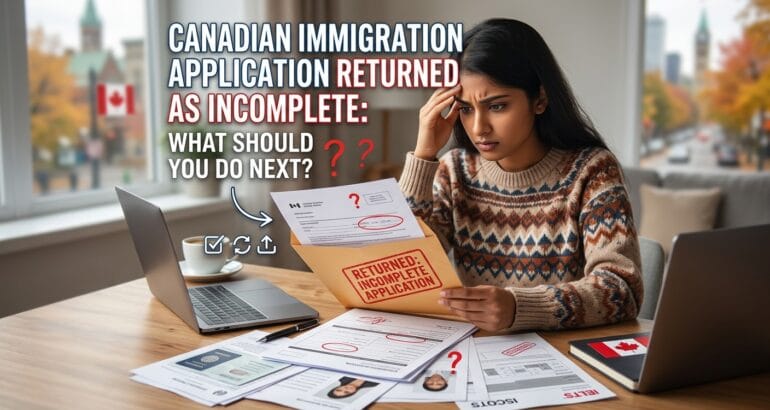
Receiving a notice that your Canadian immigration application has been returned as incomplete can be stressful, especially after spending time preparing forms, collecting documents and paying application fees. For applicants from Pakistan, the next step is to understand why the application was returned and how to address the missing information before submitting it again.
The good news is that an application returned as incomplete is not necessarily the same as an immigration refusal. In many cases, you can correct the identified problems and reapply. However, the correct procedure depends on your immigration category, the reason for the return and any deadlines that apply.
This guide explains what to do if Immigration, Refugees and Citizenship Canada (IRCC) returns your application, which documents to review, how to handle missing paperwork and how to reduce the risk of making the same mistake again.
1. What Does It Mean When IRCC Returns an Immigration Application?
IRCC reviews applications to determine whether they meet the applicable submission requirements. If an application is missing required forms, information, documents or fees, it may be returned without proceeding to a full assessment.
Common reasons include:
- Missing mandatory application forms.
- Incomplete answers or unanswered questions.
- Missing signatures or declarations.
- Required supporting documents not included.
- Incorrect or missing application fees.
- Documents that do not meet the relevant submission instructions.
- An application submitted after a program closed or reached its intake limit.
The exact requirements depend on the immigration program. For example, a permanent residence application may have a different document checklist from a visitor visa, study permit or work permit application.
If IRCC returns your application, read the accompanying letter, notification and document checklist carefully. These should help you identify the reason for the return and explain what needs to be addressed.
You can also review IRCC’s official guidance: My application was returned because something was missing.
2. Is an Incomplete Application the Same as a Visa Refusal?
No. Understanding the difference is important because the next steps may be different.
Application returned as incomplete
An application may be returned because it does not meet the requirements for a complete submission. In such cases, IRCC may not have assessed the applicant’s eligibility in the same way it would assess a complete application.
Depending on the program and circumstances, you may be able to correct the missing items and submit a new application.
Application refused
A refusal generally means that an officer assessed the application and determined that the applicant did not meet one or more applicable requirements.
For example, a visitor visa may be refused because the officer is not satisfied that the applicant meets the relevant temporary residence requirements.
A refusal may require a different response, such as addressing the reasons in the decision letter before making another application.
Important: Do not assume that a returned application and a refused application have identical consequences. Check the wording of your notice and follow the instructions for your specific immigration category.
For additional information, consult IRCC’s guidance on immigration application refusals.
3. What Should You Do First After Your Application Is Returned?
Before preparing another application, identify exactly what went wrong. Rushing to submit the same application with only one missing document corrected could result in another return.
Step 1: Read the return letter carefully
Review the entire letter or message from IRCC. Identify the specific reason for the return and note any instructions about resubmission.
Pay attention to whether the problem involves a missing document, an incomplete form, a payment issue, a program intake restriction or another requirement.
If several issues are listed, create a separate checklist for each one.
Step 2: Review the document checklist
Compare your original submission with the official document checklist for your immigration category.
Check whether every required form and supporting document was included and whether each item met the applicable instructions.
Do not rely exclusively on a checklist downloaded months earlier. Requirements may change, so consult the current application guide and official instructions.
Step 3: Check your application deadline
Some immigration programs have strict submission windows or intake limits. If you received an invitation to apply, confirm the deadline that applies to your case.
For example, Express Entry applicants generally have 60 days after receiving an invitation to apply to submit their permanent residence application. A returned application can have important consequences for your invitation and eligibility.
Do not assume that the original deadline automatically resets after an application is returned. Review the program-specific rules and any instructions from IRCC before deciding what to do next.
Step 4: Confirm whether you need new forms or documents
Some previously submitted documents may still be usable, while others may need to be updated.
Check whether signatures remain valid, whether documents are still within their applicable validity periods and whether any personal circumstances have changed.
If IRCC returned your application electronically, consult its instructions about reusing the returned documents.
Step 5: Prepare a corrected submission
Address every issue identified in the return notice. Include the missing information, correct the relevant forms and follow the applicable submission procedure.
Where instructed, include the return letter and checklist with your resubmission. Keep copies of all documents and proof of submission for your records.
4. Common Documents and Forms to Review Before Reapplying
The documents required depend on the immigration pathway. The following list covers common items to check, but it is not a universal document checklist.
Application forms
Confirm that you have used the correct forms and versions for your application category.
Review every mandatory field, including personal details, address history, employment history and family information where applicable.
If a question does not apply to you, follow the form instructions rather than leaving it blank without checking what is required.
Signatures and declarations
Check whether all required signatures and declarations have been completed in the correct manner.
Some online applications use electronic declarations, while certain paper applications require signatures in a specified format. Follow the instructions for your particular form.
Identity documents
Verify that names, dates of birth, passport information and other identifying details are consistent across your application.
If there are differences in spelling, previous names or other personal details, provide the explanations and supporting records required for your circumstances.
Financial documents
If your application requires evidence of funds, confirm that the relevant statements, financial records or other supporting documents are included.
For programs with specific financial requirements, make sure your evidence follows the current instructions. Do not assume that submitting a bank statement alone will satisfy every financial documentation requirement.
Employment and education records
Where applicable, review employment letters, educational credentials, transcripts, language test results and other documents required by your immigration category.
Confirm that the documents are legible and that the information is consistent with the details entered on your forms.
Translations
If a document is not in English or French, check the translation requirements for your application.
IRCC may require a translation and additional supporting documentation. The precise requirements depend on the document and application instructions.
Application fees
Check that you paid the correct fees for the relevant application and included any required proof of payment.
Fee requirements can change, so verify the current amount through the official IRCC website rather than relying on an old receipt or third-party article.
5. What If You Cannot Obtain a Required Document?
Sometimes an applicant cannot obtain a required document before submitting an application. For example, a police certificate may be delayed by the issuing authority, or another document may be unavailable for reasons outside the applicant’s control.
Do not simply ignore the missing item.
IRCC advises applicants who cannot obtain a required document to explain the situation in a letter and provide supporting evidence. Depending on the application process, the letter and evidence may need to be uploaded together in place of the missing document or included in a paper submission.
Useful supporting evidence may include:
- A receipt or confirmation showing that you requested the document.
- Correspondence with the issuing authority.
- A delivery confirmation or tracking number.
- An official notice explaining the delay.
- A clear explanation of the steps you have taken to obtain the document.
However, submitting an explanation does not guarantee that IRCC will accept the application as complete or approve it. The reviewing officer determines whether the evidence is sufficient under the applicable rules.
Before submitting, review IRCC’s official guidance on missing supporting documents.
6. Will IRCC Refund Your Application Fees?
Refunds depend on the circumstances and the type of fee paid.
IRCC states that applicants generally receive a refund when an application is returned in circumstances such as being incomplete, submitted before a program reopened or received after a program reached its intake limit.
Biometrics fees are subject to separate rules. For example, IRCC states that the biometrics fee is refunded when biometrics were not provided or were provided by mistake in applicable circumstances.
Refunds can take time to process. If you believe you are eligible for a refund, check the official instructions and keep your payment records.
You can review the current policy here: IRCC — If my application is returned, will I get a refund?.
Do not assume that every fee is automatically refundable in every situation.
7. How Can You Avoid Another Incomplete Application?
After identifying the reason for the return, use a structured review process before submitting again.
Use the latest application guide
Download the current guide and document checklist from the official immigration program page. Check the date and make sure you are following the correct instructions for your application category.
Complete every mandatory field
Review each form from beginning to end. Follow the instructions for questions that do not apply to you and make sure your answers are complete and consistent.
Check every supporting document
Use a checklist to verify that all required documents are included, readable and prepared in the required format.
Do not assume that a document is optional simply because it seems less important than the other items.
Review all signatures and declarations
Confirm that each form has been signed or electronically declared in the required manner. Check that the principal applicant and any other required individuals have completed their respective sections.
Verify payment requirements
Check the current fee schedule and ensure that all required payments have been made using the accepted process.
Review your information for consistency
Compare your forms and supporting documents for discrepancies in dates, addresses, employment history, education, family information and other relevant details.
If an inconsistency requires an explanation, follow the official instructions for providing it.
Keep a complete copy of your submission
Save the final forms, supporting documents, receipts and submission confirmation. If you need to address a problem later, these records can help you understand exactly what was submitted.
Consider qualified professional assistance
If your case involves complicated documentation, multiple previous applications, unusual circumstances or uncertainty about the applicable rules, you may wish to consult an appropriately authorized immigration professional.
Professional assistance can help you identify potential gaps, but no representative can guarantee that IRCC will accept or approve an application.
8. A Practical Checklist Before You Resubmit
Use this checklist to review your application before sending it again.
Return notice
- I have read the full return letter or notification.
- I understand the reasons stated for the return.
- I have identified every missing or incorrect item.
- I have checked the deadline and applicable resubmission instructions.
Forms and documents
- I am using the correct application forms and current instructions.
- All mandatory fields have been completed.
- All required signatures and declarations are present.
- All required supporting documents are included.
- Documents are clear, legible and in the accepted format.
- Required translations and supporting records are included.
- I have explained any unavailable document where the instructions allow this.
Fees and submission
- I have verified the current application fees.
- I have completed the required payments.
- I have included the return letter and checklist if instructed.
- I have followed the correct online or paper submission procedure.
- I have saved copies of the complete application and proof of submission.
This checklist is a preparation tool. Your official application guide and IRCC instructions take precedence if they specify additional or different requirements.
Frequently Asked Questions
Can I reapply after IRCC returns my application as incomplete?
In many cases, yes. You must correct the identified issues and follow the instructions for your immigration category. However, eligibility, deadlines and program availability may affect whether you can submit again.
Will an incomplete application affect my future Canadian visa applications?
A return for incompleteness does not automatically mean a future application will be refused. Nevertheless, you should correct the original problems, provide accurate information and follow the applicable instructions when applying again.
Do I need to pay the application fee again?
It depends on the circumstances and whether the original fee was refunded or remains usable under the applicable process. Check IRCC’s refund instructions and payment requirements before resubmitting.
Can I use the same documents from my returned application?
Some documents and payment receipts may be reused. However, you must check whether the documents are still valid, whether signatures remain acceptable and whether the resubmission instructions allow their reuse.
What if I believe IRCC returned my application by mistake?
Review the return notice and compare it with the official program requirements. IRCC states that if an application was returned by mistake, it may use the original receipt date. Follow the official process for your situation and keep evidence of the original submission.
Should I submit a letter of explanation with my new application?
Include an explanation when it is required or when it helps address a missing document or a change in information, following the relevant instructions. A letter should clearly explain the issue and include supporting evidence where appropriate. It does not replace a mandatory document unless IRCC’s instructions permit that approach.
Need Help Reviewing Your Canadian Immigration Documents?
An application returned as incomplete can create uncertainty, particularly when you have already invested time and money in preparing your documents. The most important step is to understand the reason for the return and determine what is required before making another submission.
Sun Consulting provides immigration consultation and application-related guidance for individuals exploring Canadian immigration options. If you need help understanding your document checklist or organizing your application materials, you can contact the team to discuss your circumstances.
Visit: Sun Consulting Pakistan
Contact the team: Sun Consulting Contact Page

Afzal Ghazi

Leave a Comment